
An information page for parents, caregivers, and community members
Lice is a widespread occurrence in many schools across Toronto. Don’t panic! It is not your fault that your child has lice. There is no blame or shame in lice, they LOVE everyone.
What is Lice?
The head louse is an insect that lives and breeds on the human head.
Lice have 3 stages – the egg (nit), the nymph, and the adult.
- Nits are whitish-grey, tan, or yellow ovals and they are about the size of a grain of sand. They stick to the hair close to the scalp and can look like dandruff. Nits hatch into nymphs in 9 – 10 days
- Nymphs are baby lice
- Adults can be hard to see since they are about the size of a sesame seed. Adult lice can live for up to 30 days on a person’s head, but they will die within 2 days from the scalp.
Head lice do not live on pets or any other parts of the body. Anyone and everyone can get lice so it’s up to us to work together to prevent outbreaks and curb the spread.
| What can be signs of lice? | 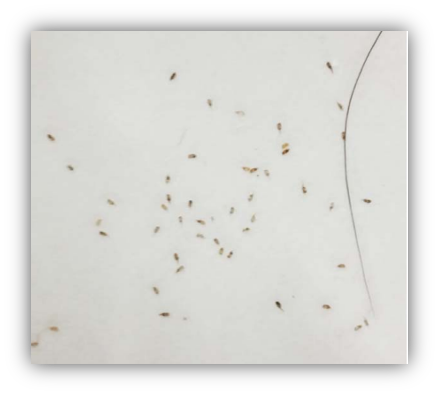 |
Doing A Proper Lice Check and Comb Through
 | By combing them out of the hair and wiping them onto a white paper towel, the nits become visible. This technique is used both to check for lice and nits and also to remove them during treatment. |
- Begin by purchasing a good quality lice comb that is made of sturdy metal and has tines that will not damage hair.
- The person doing the checking should tie back their own hair.
- Nits attach to one spot on the hair shaft, you will need to comb the entire head in all 4 directions: front to back, back to front, left to right and right to left.
- Working with small sections at a time, comb through the hair from the roots all the way through to the ends, bringing the comb right down past the ends of the hair. The comb works by sliding the eggs off of the hair so it’s important to bring the comb completely through the hair as opposed to stopping just shy of the ends and pulling the comb out to the side. If you do that, the nits may just end up near the ends of the hair.
- Comb each section a few times. Every few strokes, wipe the comb off onto a piece of paper towel and check for any lice and nits.
- Discard the paper towel in a plastic bag that can be sealed.
If you find something, it’s time for treatment!
| If you’re doing the combing as part of a treatment, continue combing each small section until no additional lice or nits are found and then move to the next section. Once finished, launder the clothes worn during the combing. Clean the brushes and combs used by first wiping off the comb completely and removing all hair. Soak the combs and brushes in hot soapy water for 10 minutes or place them in a sealed plastic bag in the freezer for 24 hours. *Adding a lice check into your bathing routine is a good way to introduce regular checks without alarming your child. |  |
We found lice, now what?
It may seem embarrassing at first, but getting lice is nothing to be ashamed of. We’re all in this together.
Important: Report it to Earl Haig Public School to help prevent further spread. If your child is in a daycare program, please report it to them as well.
Typically, lice treatments work by paralyzing or suffocating lice so that they can be manually removed. With any treatment option, all lice, and nits present in the hair must be manually removed for the treatment to be successful.
Lice and nits cannot be simply washed out of the hair.
If one member of your household has lice, be sure to check everyone else in your home as well. All family members with lice should be treated at the same time so that lice do not continue spreading within and outside your household.
- Visit a lice removal company (Nit Wits, The Lice Squad etc.) to have a treatment done professionally. This can be costly but it can be faster and easier than doing it yourself.
- Treatments can be done at the clinic or your house and the staff will teach you a lot while they work.
- Talk to a pharmacist. A pharmacist can help you choose a head lice product that is right for you. Products suggested by the pharmacist are proven effective if they are used as directed.
- Other treatments – Home remedies such as mayonnaise, petroleum jelly, olive oil, vinegar or margarine, may make it hard for the lice to breathe, but they probably will not kill them.
- There is no evidence that tea tree oil or aromatherapy works to treat head lice.
(Resource 2024 Canadian Pediatric Society)
How Do I Clean My Home?
Cleaning should be done after your first big treatment and can be repeated after a follow‐up treatment, if needed.
Concentrate on the items that could have come into contact with the person who has lice within the last 24-48 hours. (e.g. sheets, bedding, towels, brushes, stuffies, clothing, hats, outerwear, couch cushions, car seats, head rests)
- Anything that can safely be put in the washer, should be washed with hot water. Items that can be put in the dryer should be placed on high heat for 20-30 minutes.
- Note: If you are washing sheets and cannot dry them on high heat, put them aside for 2 days before putting them back on the bed (see number 3 below).
- Vacuum items that cannot be dried (carpets, rugs, couches, car seats, large stuffies (etc.)
- Any items that cannot be washed/dried on high heat or vacuumed, should be set aside for 2 weeks in an airtight plastic bag (garbage, recycling, or Ziploc) – shopping bags often have little holes.
- Remove all hair from brushes and combs and soak them hot soapy water for 10 minutes
How to Help Prevent Head Lice
- Prevent head-to-head contact and don’t share items that come in contact with heads (e.g. brushes, combs, hats, scarves, earmuffs, stuffies, pillows, clothing.
- Educate your children about how lice are spread
- Store your child’s hat in their backpack, tuck in the sides of their hood
- Check your child’s head weekly for lice and routinely check all members of the household
Lice Facts
- Lice is a worldwide problem, it is estimated that up to 12 million infestations occur each year
- Typically, only 50% of people experience symptoms once they have lice and the symptoms don’t usually appear for about 2 weeks (another reason why it’s important to do regular lice checks).
These symptoms can include: - Itchiness of the scalp. The itchiness is a reaction to an allergen in the saliva of the louse, which is secreted as the louse feeds
- A tickling or crawly feeling in the hair
- Sores from scratching or tiny red marks from where the lice have fed
- The sight of live bugs
- Difficulty sleeping as lice are nocturnal
- Remember that all lice and nits need to be removed from a person’s head for a case of lice to be considered properly treated. If any nits remain, they can hatch and the lice infestation can begin all over again.
Very Important Information
- Treat yourself with kindness
- Be sensitive to other people’s feelings. People with head lice should not be made fun of or made to feel embarrassed
- As a community, we can work together to help prevent the spread of lice. Communication, compassion, understanding, and education are the keys to removing lice at our school
Resources
Special thanks to the parents and caregivers in our community who pulled together this toolkit and to the following resources for their immeasurable information and guidance:
- Toronto Public Health
- Canadian Pediatric Society – reviewed in 2024
- Caring for Kids – Info for parents from Canadian Pediatricians
- Wilkinson Public School Lice Information
- Reviewed for accuracy by a retired nurse
 The Eagles' Nest